Are shopping-cart token keychains good conference swag?
Shopping-cart token keychains can solve a recurring problem for the right retail audience, but regional compatibility and narrow usefulness make them a conditional giveaway.
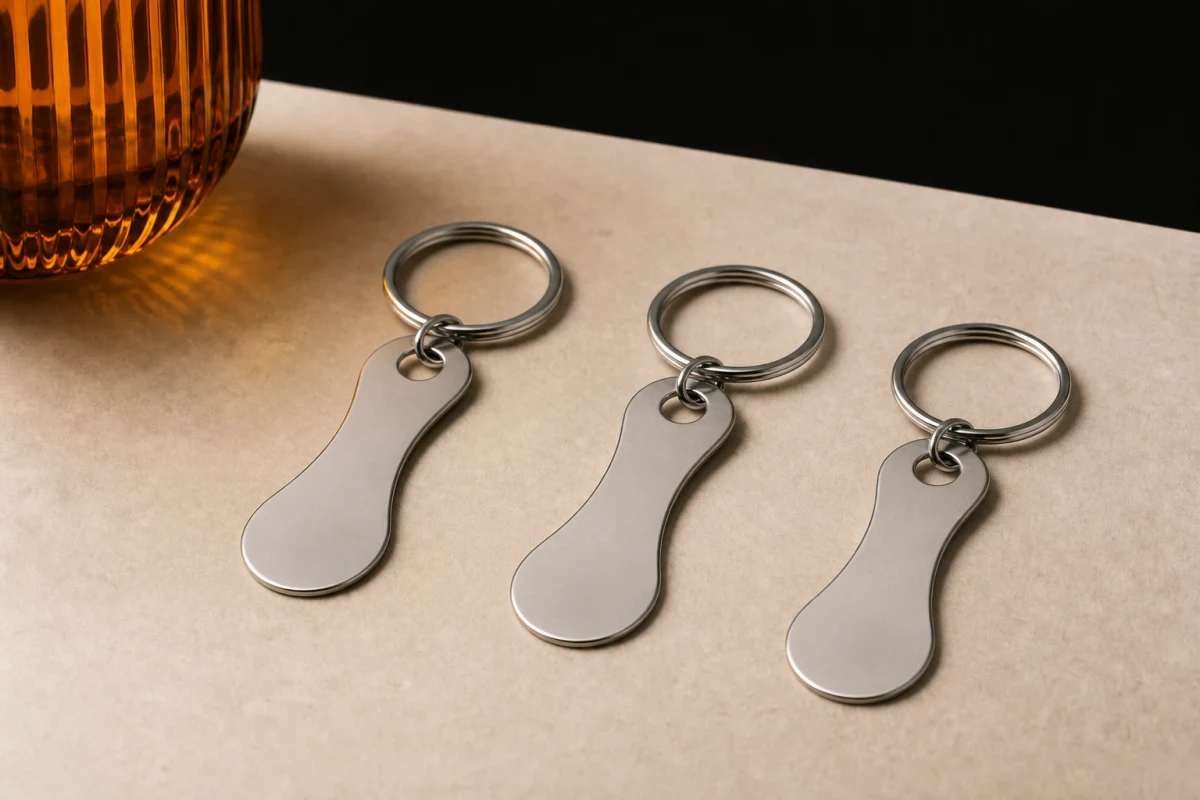
Shopping-cart token keychains are good conference swag only for an audience that regularly encounters coin-lock carts. They solve a small, repeatable problem, but an incompatible token or a recipient who never needs one turns the item into an oddly shaped piece of metal.
Review at a glance
| Factor | Assessment |
|---|---|
| Indicative unit price | $0.62–$1.10 at 500 customized units |
| Common minimum | 200–300 units |
| Visitor value | Medium for a well-matched retail audience; low otherwise |
| Recommended distribution | Conversation-qualified |
| Best for | People who routinely use compatible coin-lock shopping carts |
| Main risk | The token does not fit the recipient’s local cart locks |
| Verdict | Conditional choice |
The medium visitor-value rating is an editorial assessment of likely usefulness for a matched audience, not evidence that the item improves booth traffic or conversion. Its value depends more on the recipient’s normal shopping environment than on the imprint.
Where this item earns its place
A token keychain has a clear job: it stays with the user’s keys and replaces the coin needed to release a shopping cart. That makes it credible for grocery technology, retail operations, payments, consumer packaged goods, or other exhibitors whose visitors can immediately connect the object to their work or routine.
The useful versions are compact, smooth-edged, and simple to operate with one hand. A key-shaped token that can be removed after releasing the cart may be more convenient than a detachable round token, but that advantage must be verified on the actual cart lock rather than inferred from its shape.
Why it fails or creates waste
Compatibility is the central weakness. Suppliers offer different token diameters for different coin standards, while pull-out designs depend on the shape and depth of the cart mechanism, so “works with shopping carts” is not a sufficient specification.
The audience fit is equally narrow. Someone who shops where carts are unlocked, carries a suitable coin already, uses delivery services, or rarely buys groceries has little reason to add another object to a key ring. Small engraving areas also tempt buyers to reduce a detailed logo until it is technically present but practically unreadable.
What the price range means
On August 21, 2026, 4CustomPromo listed a stainless-steel trolley token keychain at $0.62 each for 500 units with laser engraving. The item measures 60 × 25 × 2 mm, has a 300-unit minimum, and carries a separate setup charge.
At the same quantity, Imprint5 listed a zinc-alloy trolley release token at $1.10 each with laser engraving. Its 200-unit minimum and choice of 23, 25, or 26.5 mm coin sizes illustrate why the buyer must specify the intended cart system before ordering.
The three-piece Bilkeru set on Amazon that prompted this review was listed at $5.28, or $1.76 per unbranded token, on the same date. The listing describes a 55 × 23 × 1.7 mm stainless-steel pull-out design; it is a plausible retail sample, not a customized bulk-price comparison or a Booth Lab-tested recommendation.
Add setup, freight, tax, rush production, extra imprint locations, packaging, and venue handling to the quoted unit price. A low-cost token that needs replacement after a compatibility failure is not the cheaper order.
Test it on the carts your audience uses
Obtain a production-equivalent sample in the correct material and thickness, then test it on several cart locks from the intended market. Do not approve a full run from a digital proof or from one successful attempt on one cart.
Check that:
- The token enters and releases the lock without force.
- A pull-out version exits cleanly without scraping or catching.
- A detachable coin stays secure on the keychain between uses.
- Edges are smooth and the item remains comfortable beside keys in a pocket.
- The ring and connector survive repeated pulling and twisting.
- The engraved company name remains legible at actual size.
Record the cart brands or lock types tested and keep the failed combinations with the purchasing notes. If the supplier cannot provide a production-equivalent sample or a clear compatibility specification, skip the item.
Use a qualification question, not a giveaway bowl
Keep the stock behind the counter and offer it after a relevant retail or grocery conversation. A practical qualification question is, “Do the carts you use normally need a coin or token?” followed by a compatibility check for the market the visitor describes.
This rule prevents broad distribution to people who cannot use the item and gives booth staff a reason to explain what it does. Track the number offered, the number accepted after the explanation, and any reported compatibility failures after the event.
Final recommendation
Buy shopping-cart token keychains when the audience routinely uses coin-lock carts, the correct mechanism is known, and a production sample passes testing on representative locks. Skip them for a general conference audience, an uncertain geographic mix, or any order whose compatibility claim goes no further than “universal.”
Use the conference swag selection guide to compare the job, recipient, landed cost, and distribution rule. Browse the conference swag library for items with broader everyday usefulness.
Next steps
Useful next steps
Guides
How to choose conference swag that earns its place
A practical method for choosing, sampling, distributing, and reviewing conference giveaways without buying clutter.
Guides
Are AirPods cases good conference swag?
AirPods cases are compact and inexpensive, but exact-generation compatibility sharply limits the audience and makes model identification essential.
Guides
Are baseball caps good conference swag?
Baseball caps provide visible, durable value for the right audience, but fit and conspicuous branding make them a poor universal handout.