Are USB-C adapters good conference swag?
USB-C adapters can solve a real travel problem, but the shared connector hides major differences in data, display, and power behavior.
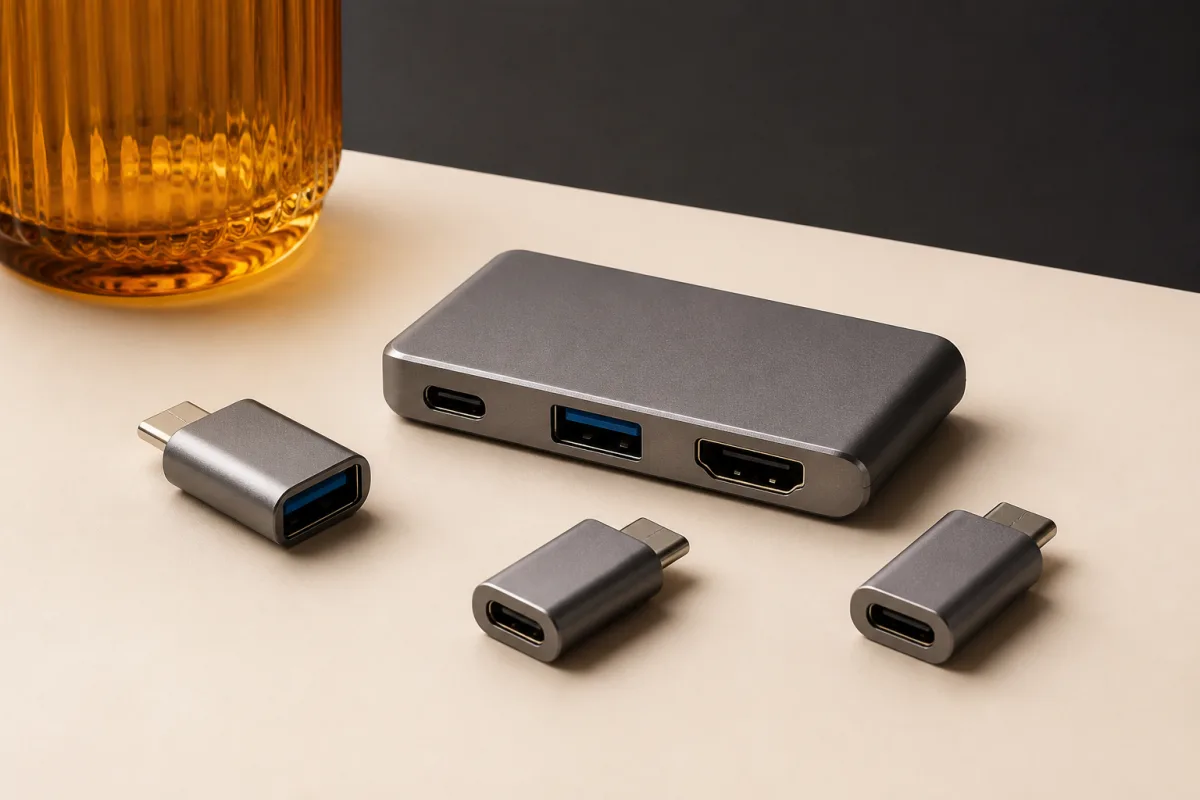
USB-C adapters are useful selective swag only when one clearly labeled function matches the audience. Treating USB-C as one universal capability invites disappointment because identical-looking ports can support different power, data, and display features.
Review at a glance
| Factor | Assessment |
|---|---|
| Indicative unit price | $3.39–$12.00 each |
| Common minimum | 50–75 units |
| Visitor value | Medium |
| Recommended distribution | Conversation-qualified |
| Best for | IT, developer, travel, AV, and hardware audiences with a clearly defined port need |
| Main risk | USB-C connector shape does not guarantee data speed, video, charging, or host compatibility |
| Verdict | Conditional choice |
Visitor value is an editorial assessment of likely usefulness and fit, not a measured engagement or conversion result. Validate the decision with your own audience and a production-equivalent sample.
Where this item earns its place
A simple USB-A-to-USB-C adapter or compact hub can fit developer, IT, AV, travel, and hardware audiences that routinely bridge old and new peripherals. The giveaway should solve one named connection problem rather than promise a miniature docking station to everyone.
Why it fails or creates waste
The connector alone does not reveal USB generation, transfer speed, video-alt-mode support, power delivery, or whether the adapter is host- or device-facing. Loose sockets, inadequate shielding, heat, and unclear directionality make low-cost models especially risky.
What the price range means
On August 21, 2026, 4imprint listed the Transport Hub with USB-C at $3.39–$5.15 across its quantity range, while more capable promotional hubs commonly move above $5 as ports and power features are added. Obtain a quote at one quantity with the full port specification, then add setup, freight, tax, packaging, and enough samples for compatibility testing.
Test the sample before approving production
Use a production-equivalent sample, not only a digital artwork proof, and perform the test under the conditions a recipient will face. Record pass-or-fail results so price does not quietly overrule a real compatibility or quality problem.
- Documentation identifies every port, USB version, direction, and maximum transfer rate.
- Adapter works with representative Windows, macOS, Android, or other intended hosts.
- Any claimed video output and power pass-through work simultaneously at the stated limits.
- Housing remains secure and acceptably cool during a 30-minute transfer or charge.
- Package avoids the word universal unless the supplier can define its scope.
Test the exact production sample with the cables, chargers, displays, and hosts named in your intended use case. A logo proof is not enough because an electrically different production substitution can change the result.
Distribution rule
Distribute only after a relevant connection problem emerges in conversation, and let the recipient confirm the port they need. Avoid an open bowl because visitors cannot validate compatibility from appearance alone.
Final recommendation
Choose a USB-C adapter when the task is narrow, the specification is explicit, and the sample works across the intended device set. Skip it when the pitch depends on the USB-C shape doing more than the documented electronics support.
Use the conference swag selection guide to compare the job, recipient, and landed cost. Review other options in the conference swag library before committing the order.
Next steps
Useful next steps
Guides
How to choose conference swag that earns its place
A practical method for choosing, sampling, distributing, and reviewing conference giveaways without buying clutter.
Guides
Are AirPods cases good conference swag?
AirPods cases are compact and inexpensive, but exact-generation compatibility sharply limits the audience and makes model identification essential.
Guides
Are baseball caps good conference swag?
Baseball caps provide visible, durable value for the right audience, but fit and conspicuous branding make them a poor universal handout.